
Best Hiking Socks Guide
Best Hiking Socks Guide: Fit, Materials, Testing, Care

Introduction
Most people asking for the best socks for hiking are secretly asking a different question: “How do I stop my feet from turning on me halfway up the trail?” Fair. Feet are traitors.
If you want the clean, corporate answer up front, here it is: the best hiking socks are the ones that fit your footwear volume, manage sweat before it turns into friction, and keep their shape after repeated washes, and for a lot of hikers the most reliable “do-it-all” pick is the Darn Tough Hiker Micro Crew Cushion because it nails the boring stuff (fit, moisture handling, durability) and backs it with a lifetime guarantee, which is the sort of confidence you only show when you know your knitting will not fall apart.
But you do not actually have “a best sock”. You have a sock system. Hot days. Cold days. Boggy UK slop. Dusty switchbacks. Trail running shoes one weekend, hiking boots the next. If anyone tells you one pair handles all of that perfectly, they are either selling you something or they have never had truly sweaty feet in August.
This guide is about performance, not vibes: blister prevention, comfort, temperature regulation, moisture management, and durability. Then choosing fabrics, cushioning, height, fit, and when to bother with liners, toe socks, or waterproof socks. I’ll also lay out how to test and compare pairs like gear, not like a fashion accessory you chuck in a drawer next to comfy slippers and forget.
What makes a pair worth buying?

A hiking sock earns its keep when you stop thinking about it. No hot spots. No bunching. No weird sagging around the arch. No “why does my heel feel like it’s being sanded” drama.
There are loads of decent socks, even some cheap ones, but the best hiking socks tend to share a few non-negotiables. Not marketing features. Actual on-trail behaviour.
-
Friction control: that means a stable fit, a smooth toe seam (or genuinely seamless), and a knit that does not slide when your foot gets damp.
-
Moisture management: sweat has to go somewhere. If it stays on your skin, you are basically marinating your feet until the skin softens and blisters show up.
-
Thermal regulation: warm when you stop, not boiling when you climb. This is where the benefits merino socks crowd won’t shut up, and they have a point.
-
Durability in the heel and toe: holes are not “wear”, they are failure. If the heel goes shiny and thin after a handful of hikes, bin it.
-
Volume compatibility: the right socks in the wrong boots are the wrong socks. Stuffing heavyweight hike socks into a snug hiking shoe is a blister factory.
You can obsess over compression socks, “air channels”, “performance zones”. The reality is simpler: fit plus moisture control plus a sensible cushion level will beat gimmicks most of the time.
Blister prevention
Blisters are friction injuries. That’s the core. Friction spikes when skin is damp, when fabric moves against skin, or when your footwear fit is off and your foot slides.
So blister prevention is not a single trick. It is a stack.
A good hiking sock reduces shear forces by hugging the foot consistently. Arch support helps, not because it magically “supports” anything in an orthopaedic sense, but because it stops the knit from migrating and wrinkling under load. A stable heel pocket matters for the same reason. If your heel lifts in your hiking boots and the sock follows it like a loose sleeve, you will feel it as heat first, then pain, then that grim squelchy tenderness later.
Hot spots are early warnings. Do not play tough. Stop, fix it. Change socks. Adjust lacing. Tape. A sock that gives you repeated hot spots in the same place is not “nearly perfect”, it is wrong for your foot shape or your footwear.
If you want a medical-ish confirmation that this is about friction management, the American Academy of Orthopaedic Surgeons has straightforward guidance on blisters and prevention that aligns with what hikers learn the hard way, just without the salty language.
Moisture and heat
Sweat is inevitable. Even in cold weather. Especially in cold weather, oddly, because you overdress, you push, then you cool down and now you have damp feet in wind. Lovely.
Moisture management is about moving perspiration away from the skin and spreading it through the knit so it can evaporate. Merino wool does this well and stays pleasant when damp. Many synthetics do it well and dry faster. Either can work. The failure mode is the same: wet skin plus movement equals friction, friction equals blisters.
Heat is not just “warmth”. It is overheating on climbs, then chilling when you stop. Good hiking socks smooth that out. A decent merino blend can feel oddly temperature-neutral, which is why you see it on everything from lightweight hiking socks to heavyweight mountaineering socks. If you want the brand-level technical angle, Icebreaker’s explanation of merino’s thermoregulation and moisture behaviour is one of the clearer summaries of why wool performs the way it does, even if you do not buy their socks.
Durability and comfort
Durability is not glamorous, but it is the trait that saves you money and irritation. You can have the softest merino socks in the world, but if the toe abrades through because your hiking feet are hammering the front of a snug toe box, you will be shopping again in a month.
Comfort is not just “cushion”. Comfort is a lack of friction, a lack of pressure points, and a knit that does not twist. Thick cushioned socks can feel lovely at first touch, then turn into a sweaty, cramped mess once your feet swell after a long day. That swelling is normal, by the way. Plan for it.
This is also where “day sock comfort” and real-world comfort diverge. The socks that feel like a spa at home are not always the ones that behave under load. Your feet do not need luxury. They need stability.
Choose fabrics that match your conditions
People get weirdly tribal about wool versus synthetic socks. I get it. Nobody wants to admit they bought the wrong thing. Still, fabric choice is mostly about conditions, sweat rate, drying time, and your tolerance for odour.
A simple way to think about it is: what happens when this gets wet, and how quickly can it recover? That is the whole game on a trail that goes from sun to shade to a stream crossing to a windy ridgeline.
Here’s a practical comparison table I wish more shops would just stick on the wall.
|
Fabric type |
What it does well |
Where it bites you |
Who it suits |
|---|---|---|---|
|
Merino blends (wool + nylon) |
Temperature regulation, odour resistance, stays comfortable when damp |
Can take longer to dry than pure synthetics, can feel warmer in high heat |
Most hikers, mixed conditions, multi-day trips |
|
Synthetic socks (polyester/nylon blends) |
Fast drying, strong wicking, often cheaper |
Can get pongy quickly, some feel slick and can slip if fit is off |
Hot climates, high sweat rate, budget buyers |
|
Cotton socks |
Soft in the shop, familiar |
Holds water, increases friction, chills when wet |
Nobody on purpose, except people who enjoy suffering |
Merino blends
Merino wool gets treated like magic. It is not magic. It is just an animal fibre with useful properties: it can buffer moisture, it insulates even when damp, and it is less prone to stinking you out on day two.
The best merino wool hiking socks are rarely pure wool, though. They are blends. You need nylon (or similar) for abrasion resistance, shape retention, and to stop the heel turning into a ghost after a few washes. This is why “benefits merino socks” are usually really “benefits merino blends”.
For wet and changeable hiking condition days, merino blends are the easiest default. Muddy UK trails where your feet get damp and stay damp, mountain paths where you sweat on the climb then cool on the descent, shoulder season trips where you do not want to pack five pairs. Merino just behaves.
If you are the kind of person who wants receipts, the practical sock-selection logic in REI’s expert advice on choosing hiking socks is a decent sanity check, even if you never buy anything from them. Materials, cushioning, fit. No mysticism.
Synthetics and Coolmax
Synthetics have an unfair reputation as “cheap”. Some are. Some are excellent. The big advantage is drying speed. If you are hiking in genuine heat, or you are in trail shoes and you want your feet to vent, a light sock in a good synthetic blend can feel more controlled than wool.
Coolmax is basically a branded approach to polyester socks designed for wicking and drying. When people say “I cannot do wool”, whether that is itch, allergy, or just personal preference, this is where you look. Also if you are a heavy sweater and merino socks feel swampy on climbs, synthetics can be a relief.
The danger is slippage. Some synthetic socks feel slick against the foot. If the fit is not spot-on, you can get movement, and movement is the whole blister story again. So you cannot half-guess sizing.
Cotton and other misses
Cotton socks are great for sitting on the sofa. Hiking in them is self-sabotage. Cotton holds moisture, stays wet, and turns into a friction amplifier. It also gets cold when wet, which is exactly what you do not want when you stop for lunch and the wind picks up.
There are other misses too: bargain “sports” show socks that look fine but collapse inside boots, novelty knits, anything with a thick raised toe seam. Traditional crew socks made for casual wear are not the same thing as crew socks designed for hiking. The knit structure, fibres, and reinforcement matter. A lot.
Pick cushioning, height, and fit correctly

This is where people make the mistake that ruins otherwise good purchases: they buy the “best” hiking sock, then they wear it in the wrong footwear, on the wrong day, at the wrong thickness.
Your sock is part of the shoe fit equation. Change the thickness and you change the volume. Change the height and you change how the cuff interacts with your boot collar. Change the knit tension and you change slippage.
Cushion levels
Cushion is not moral virtue. More is not always better. Cushion is a tool.
Lightweight socks tend to work when breathability is your main problem and your footwear already has cushioning, like trail running shoes or a light hiking shoe. They can also be brilliant in hot climates because you reduce insulation and bulk. The risk is impact protection on rocky terrain, and less padding to mask small fit issues.
Midweight socks are the boring sweet spot. Enough padding to take the edge off stones, enough structure to hold shape, not so much that your boots feel tight. If you only owned one category, this is the sensible one.
Heavyweight hiking socks, full cushion socks, and the whole heavyweight mountaineering socks world make sense when it is cold, when you are carrying weight, when you are in stiffer boots, or when you are out for long winter days where warmth and protection matter. The risk is overheating, and cramming toes. Toe pressure plus downhill equals bruised nails and misery.
A winter hiking sock should feel warm without feeling like your foot is stuffed into a duvet. If it does, your boot volume is probably wrong for that thickness.
Crew vs quarter vs knee
Height is not just style. It is protection and interface.
Crew socks are the standard because they sit above most boot collars and reduce rubbing. Micro crew socks sit a bit lower, which can be perfect with mid-height boots or trail shoes where you still want coverage over the ankle area without feeling like you are wearing a knee tube.
Quarter socks and ankle socks can work in trail shoes on dry days, but they are more exposed to grit and debris. Low cut sock territory is where you discover that one tiny pebble can ruin your mood for an hour. Gaiters help, but most people do not wear them on casual hikes.
Knee-high options are niche: cold, snow, mountaineering boots, or if you just like the feeling of more coverage. Ski sock style height can also be useful if your boot cuff is tall and you want a smooth interface up the shin.
Sizing and volume
Sizing is the quiet killer. Socks that are too small increase tension, pull the heel pocket out of place, and can compress toes. Socks that are too large wrinkle, and wrinkles become hot spots. This is not subtle on a long day.
Volume matters too. A thick cushion sock inside a boot fitted for thin sock use will tighten the toe box and increase friction. People then blame the sock for blisters when the actual issue is a boot fit mismatch.
If your feet swell a lot, plan for it. Try the sock late in the day, not first thing in the morning. Your hiking feet at mile 8 are not the same as your feet at breakfast.
Use liners and waterproof options with purpose

Sock liners, toe socks, waterproof socks. These are not mandatory. They are problem-solvers. Use them when they solve your problem, not because you saw a gear list online that made you feel under-equipped.
Liner socks
Sock liners exist to reduce friction by creating a sacrificial layer that moves against the outer sock, not against your skin. They also help with moisture movement if your outer sock is thicker.
They are useful when you are blister-prone, when you are breaking in stiff boots, or when you are doing long mileage day after day and your skin just gets fragile.
The downsides are real: more bulk, more heat, more complexity. If your footwear is already snug, adding sock liners can backfire by increasing pressure.
A simple “do I need a sock liner?” check:
-
You routinely get blisters in the same spots even with well-fitting boots and decent hiking socks.
-
You are doing multi-day hikes where feet stay damp and soft.
-
You are carrying a heavier pack and spending long hours on descents.
If none of that is you, liners may just be extra faff.
Toe socks
Toe socks are divisive. They look odd. They can be fiddly. They can also be genuinely brilliant for people who get blisters between toes because they remove skin-on-skin friction.
That is the whole point. Not fashion. Not “toe freedom”. Just friction control.
The obvious trade-off is fit and comfort. Some people hate the feeling. Some people love it and never go back. Toe socks can also run warmer because you add fabric between toes. If you already run hot, keep that in mind.
Waterproof socks
Waterproof socks sound like a cheat code for wet weather. In reality, they are a specialised tool, and they come with a catch: they can trap sweat.
If it is cold and wet and you need to keep feet warm, waterproof sock options can be a lifesaver. If it is mild and you sweat a lot, you can end up with damp feet anyway, just damp from the inside. Also, once a waterproof sock wets out from the top, it can feel grim.
In the UK, where wet and muddy is basically a personality trait of the countryside, waterproof socks can make sense for cold boggy days, especially if you are not in full waterproof boots. They are less convincing for summer rain where breathability is more valuable than a membrane.
Compare top models with clear trade-offs
People love rankings. I get it. Still, the only honest way to talk about “top” socks is to admit trade-offs. Cushion versus breathability. Wool feel versus drying speed. Price versus longevity.
For a quick comparison, here’s a blunt table. Not a shopping list, more like a map.
|
Model |
Best at |
The compromise |
|---|---|---|
|
Darn Tough Hiker Micro Crew Cushion |
All-round fit, durability, blister control, long-term value |
Price, and some people find it warm in peak heat |
|
Injinji Trail Midweight (toe socks) |
Preventing between-toe blisters, toe splay comfort |
Not everyone likes toe pockets, a bit fiddly to put on |
|
Bridgedale Merino Performance Hike Midweight |
Breathability and balanced cushioning, strong UK availability |
Not the cheapest, and fit feel varies by foot shape |
Darn Tough Hiker Micro Crew
This is the pair that keeps showing up as “best overall” for a reason. The knit is stable, the cushioning is in that Goldilocks zone, and the durability is not just talk. I also respect a brand that puts its money where its mouth is, and the lifetime warranty policy is exactly that.
Review round-ups keep circling the same conclusion too, from Switchback Travel’s sock comparisons to larger consumer testing like CNN Underscored’s hiking sock testing, which is basically the rare mainstream review space that still cares about long-term comfort and not just first impressions.
The main reason people bounce off these is heat or budget. If you hike in truly hot weather, or you are in trail running shoes and want the lightest possible feel, this can feel like a lot of sock.
Injinji Trail Midweight
If you are blister-prone between the toes, toe socks can feel like discovering fire. You get fabric separation, less skin-on-skin rub, and for some foot shapes it makes long hikes dramatically more comfortable.
The midweight version makes sense because ultrathin toe socks can feel too minimal on rough ground, and thick ones can feel sweaty. This is a “solve a specific problem” choice that can become your favourite hiking socks category if it clicks.
If it does not click, you will know immediately. Some people cannot stand the sensation. It is not a character flaw. It is just nerves and preference.
Bridgedale and budget picks
Bridgedale has long been a serious player in the UK and Europe, and their merino performance options tend to land in that practical midweight sock zone: breathable, supportive, not overbuilt. If you like merino socks but want something that feels a touch more “athletic” in how it manages moisture, they’re worth a look. Their own explanation of construction, like Fusion Tech and endurance knitting choices, is also a useful reminder that durability is often about reinforcement yarns and knit structure, not just “more wool”.
Budget picks are tricky because “cheap” can mean “fine” or “falls apart after three washes”. If you are going synthetic, a known performance fibre like Coolmax can be a safer bet. If you are going budget wool, look for blends with reinforcement, because pure softness without strength equals holes.
If you want another set of opinions from people who actually drag their feet through real weather, Outdoors Magic’s field-tested sock reviews tend to read like someone got rained on repeatedly, which is exactly the energy I trust.
Test and care for socks like gear

People baby expensive boots, then treat socks like disposable. It is backwards. Socks are your first interface with the trail. They deserve a bit of method.
Testing also stops you wasting money. A sock that feels brilliant around the house can fail on a steep descent once your foot starts sliding forward. You do not know until you test it properly.
Fit check protocol
Do your fit check in the footwear you actually hike in, not barefoot on carpet.
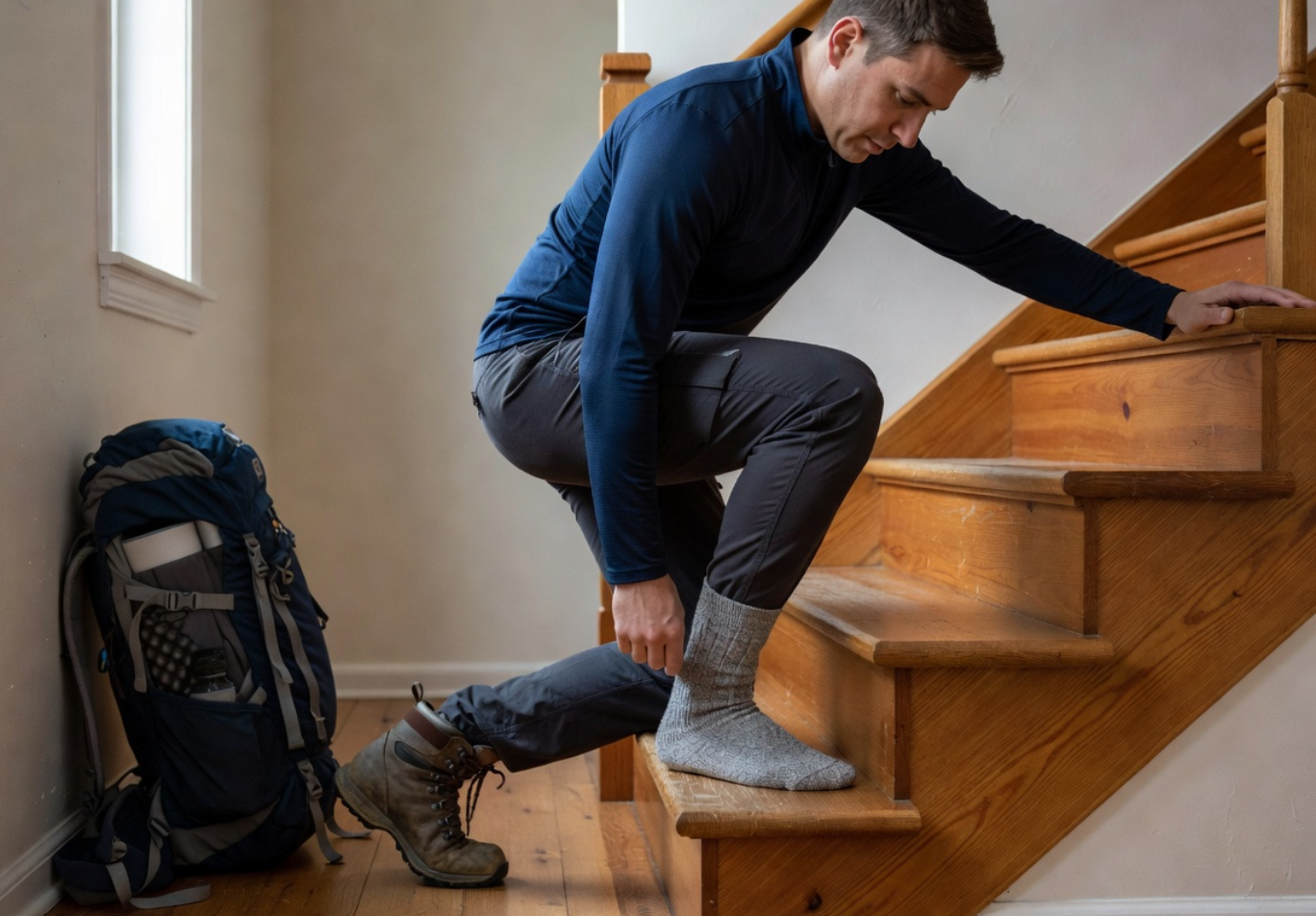
Put the sock on and take ten seconds to seat it properly: heel pocket aligned, no wrinkles under the arch, cuff flat. Then lace up and walk up and down stairs.
Now the important part: mimic hiking movement. Heel lift. Toe-off. A few deep knee bends. A short jog if you are wearing trail shoes. If the sock migrates, twists, or you feel a seam bite, it will not improve at mile 6. It will get worse.
Pay attention to the toe box. If your toes feel crowded, do not rationalise it. On a long descent, that pressure turns into black nails and friction blisters around the tips.
Field test criteria
When I test a pair, I care less about “comfort” in the abstract and more about predictable performance over time. You can do this casually, no lab coat needed.
I look for a few specific signals:
-
Do I get hot spots in the usual places, especially heels and forefoot?
-
How does it feel after it gets damp, either from sweat or weather?
-
Does it hold shape after a full day, or does it go baggy and start sliding?
-
What happens on descents, when the foot drives forward?
-
How does it smell after a couple of days, and does it recover after washing?
If you want to go full nerd, you can rotate socks across the same route and keep notes, but even a basic “same boots, same trail, different pair” comparison reveals a lot.
Wash and dry care
Sock care is not precious, but it is specific.
Wash them inside out to get sweat and grit out of the fibres. Avoid fabric softener, because it can coat fibres and mess with wicking. Use a gentle cycle if they are wool-rich. Air-drying is kinder than high heat, especially for merino blends where elasticity matters.
Also, do not store damp socks in a bag and forget them. That is how you get odour that never quite leaves, even after washing.
If you care about wool sourcing and not just performance, certifications like the Responsible Wool Standard and ZQ Merino standards are the sort of boring-but-important frameworks that signal better animal welfare and supply chain accountability. Not perfect, but better than shrugging.
FAQ
People always ask if they should size up for thicker hiking socks. Sometimes. If your boots are already snug, thicker socks will make them worse. If your boots have extra volume and you use thick socks to fill it, that can improve stability. The only honest answer is: try it in the boots, with your feet slightly swollen, and see if your toes still have room.
People ask about wearing show socks or ankle socks with hiking sandals. You can, especially in hot climates, but grit becomes your enemy and rubbing points change. In sandals, a low cut sock can slide and bunch. If you do this, pick something that hugs the arch and does not collapse.
People ask how many pairs to bring on multi-day trips. Enough to rotate so one pair can dry while you wear another. If it is wet weather, consider a third pair because nothing stays dry. Also, bring one warm socks option for camp, even if it is basically a sleep sock. Cold feet at the end of the day ruin morale.
People ask whether wool socks are itchy. Some are, some are not. Merino is generally fine for most people, but sensitivity is personal. If you hate the feel, go synthetic and stop letting strangers on the internet shame you about it.
People ask if expensive sock means better. Not always. Price can reflect better fibres, tighter knitting tolerances, reinforcement yarns, and warranties. It can also reflect branding. The only thing that matters is whether the sock survives your terrain and keeps your skin intact.
Conclusion
If your feet are happy, your whole hike gets easier. That sounds obvious, then you watch people spend hundreds on a jacket and walk out wearing cotton socks and a shrug.
Pick socks the way you pick any piece of gear: match them to conditions, match them to footwear volume, then test them hard enough that you trust them. Rotate lightweight hiking socks for heat, midweight socks for most days, and bring the heavyweight hiking socks or winter hiking sock option when cold and long mileage are on the menu. Keep the toe seam smooth, keep the heel locked in, keep moisture moving, and stop pretending a single perfect sock exists for every trail you’ll ever walk.
